
Hardwood flooring guide · Springfield, MO
Hardwood flooring guide for Springfield homes: solid vs engineered, species and finish
Real hardwood brings a warmth no look-alike quite matches, and it can last for decades with the right care. Before you fall for a color, it helps to understand the two ways hardwood is built, how wood species and finish change the look, and how wood behaves through a Missouri year. Here is what we walk through with customers at Springfield Carpet One.
Solid vs engineered hardwood
Both are real wood on the surface. The difference is underneath.
Solid hardwood is one piece of wood from top to bottom. It can be sanded and refinished many times over its life. It is usually nailed down over a wood subfloor, and it is generally not recommended below grade, such as in a basement, or directly over concrete.
Engineered hardwood has a top layer of real wood bonded to a core of layered wood or another stable material. That construction makes it less likely to expand, shrink and cup as humidity changes, so it can go in more places, including some installs over concrete or below grade when the maker allows it. Depending on how thick the top layer is, it can often be refinished, but fewer times than solid wood.
| What matters | Solid hardwood | Engineered hardwood |
|---|---|---|
| Construction | One piece of wood | Real wood top layer over a stable core |
| Refinishing | Many times | Depends on top layer thickness |
| Over concrete or below grade | Generally not recommended | Often possible, check the product |
| Movement with humidity | More | Less |
Neither is "better." The right one depends on your subfloor and your rooms, which is why we look at both at your free in-home measure.
Species: the grain and the hardness
The species sets the grain pattern, the color range and how well the floor resists dents.
- Oak is the classic. Red oak has a warmer, pinkish tone and a lively grain. White oak is cooler and more muted, and is popular in modern, light-toned floors.
- Hickory is one of the hardest common species, with dramatic color variation from board to board. Great for busy homes and rustic looks.
- Maple has a smooth, subtle grain and a lighter color. It is hard, but its smooth face can show scratches more than a heavily grained wood.
- Birch is similar to maple with a soft, even look.
- Walnut (American black walnut) is darker and richer, and softer than oak or hickory, so it dents more easily. Trade names can be misleading, since some floors sold under a walnut name are a different, harder species, so check the spec sheet.
You may hear about the Janka scale. It is a standard test for how hard a wood is. Higher numbers resist dents better, which matters with big dogs, kids and dropped pans.
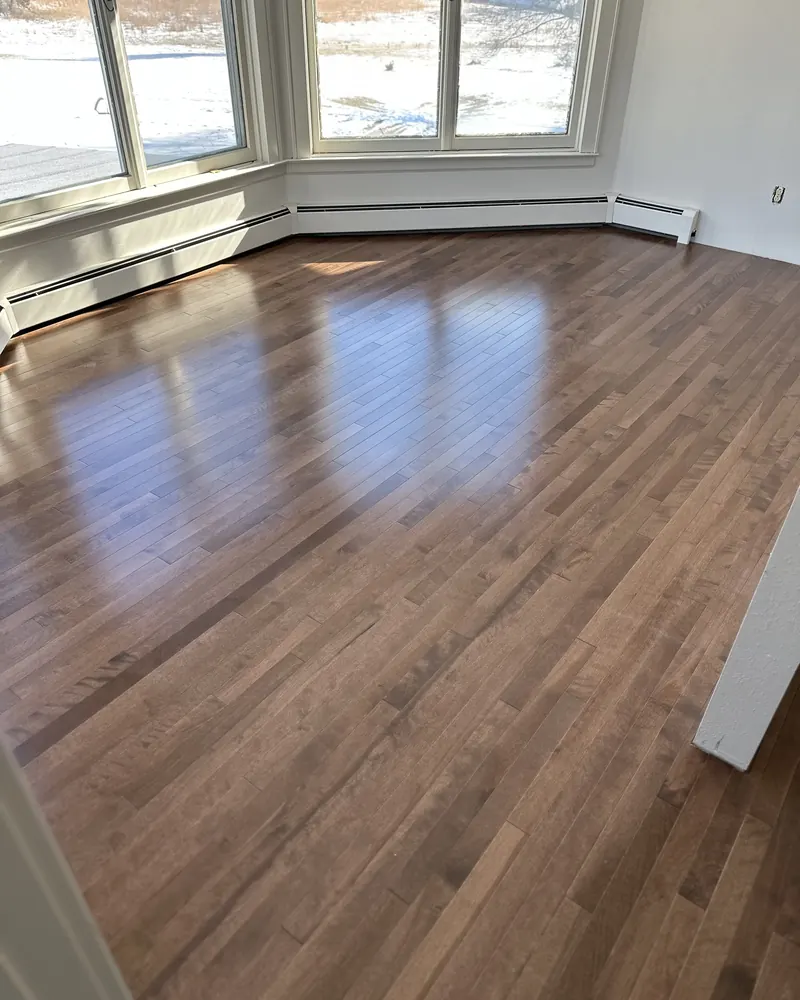
Finish, sheen and texture
- Sheen: gloss floors look dramatic but show scratches, dust and footprints. Satin and matte finishes hide everyday wear much better.
- Texture: wire-brushed and hand-scraped surfaces add character and help disguise small scratches and dents.
- Prefinished vs finished on site: many hardwood floors come prefinished from the factory, so there is no sanding or finishing in your home. Ask whether the style you like is prefinished.
Plank width and color
Wider planks show off the grain and make a room feel open, but they can show seasonal movement more. Narrower boards are a traditional look. For color, bring photos of your cabinets, trim and furniture to the showroom, and compare several boards or a larger sample so you see the full range of variation. One small chip never tells the whole story.
Hardwood and Missouri humidity
Wood moves with the air. In humid Ozarks summers it takes on moisture and swells slightly; in winter, when the furnace runs and the air dries out, it shrinks and small gaps can appear between boards. This is normal for real wood. Keeping your home's humidity steady through the year helps the floor stay flat and tight, and engineered hardwood moves less than solid.
Caring for real wood
- Sweep or vacuum often. Grit is what scratches a finish.
- Use the cleaner the floor maker recommends. Skip steam mops and wet mopping.
- Put felt pads under furniture legs and mats at outside doors.
- Wipe up spills right away.
Hardwood or wood-look vinyl plank?
Hardwood is real wood. Wood-look vinyl plank usually costs less and stands up to water better, which is why many people use it in kitchens, baths and basements and choose hardwood for living spaces and bedrooms. If you are weighing the two, read our guide to vinyl plank vs laminate and how vinyl plank installation works.
What it costs
Every style on our hardwood page shows its material price per square foot. Our hardwood lineup includes styles from Paramount, Casabella and CALI. Your installed price adds installation and includes tear-out and haul-away of your old floor. Floor prep is added only if your floor needs it, and we check at your free in-home measure.
Our online estimator prices every room and shows an installed price and a materials-only price. We serve Springfield, Battlefield, Ozark, Rogersville, Nixa, Republic and Willard. Start your hardwood estimate online, call (417) 751-0242, or visit us at 1415 E Battlefield Rd, Suite B, Springfield.